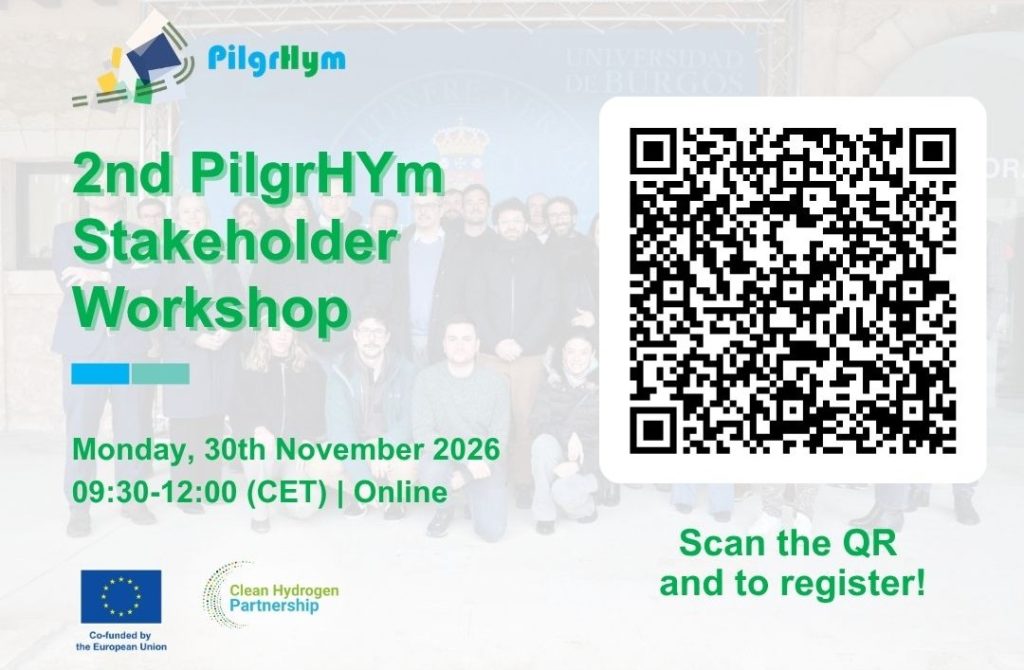
PilgrHYm will hold its second online Stakeholder Workshop on 30 November 2026, from 9:30 to 12:00 CET, to present the latest updates on the project on the safe repurposing of existing European natural gas transmission pipelines for hydrogen transport. The workshop will showcase the research carried out on areas such as material characterisation, tests on grid repurposing to hydrogen, approaches to predict hydrogen damage, guidelines to limit hydrogen embrittlement, and a review of current standards and the impact of the projects among stakeholders. Here you can find the link to register for the workshop.
After an introduction from Magali Polo, Project Manager at NaTran and PilgrHYm project coordinator, the programme will move on to the technical sessions of the workshop. Julien Schweicher, Senior Lead Domain Engineer in Materials at Fluxys, will unveil the results of the database that PilgrHYm has developed on technical information about the European natural gas transmission network of steel pipelines. That information includes representative infrastructure properties, materials and current operating conditions.
Then, the workshop will review the development of a harmonised testing matrix that combines established methodologies with innovative testing to reduce testing time and costs. Antonio Alvaro, Senior Research Scientist at SINTEF, will give the main results from the literature review carried out and will introduce the experimental inputs that PilgrHYm proposes for the tests.
Laurent Briottet, Fellow at CEA-Liten, will present the results of the experimental lab tests conducted on the representative material through the experimental input previously selected in PilgrHYm. His contribution will focus on quantifying the remaining variability from the interlaboratory tests.
The following presentation will showcase the status of PilgrHYm’s research on developing innovative numerical models for predicting hydrogen damage. Heiner Augenstein, Team Leader for Materials Modelling and Component Simulation at Fraunhofer IWM, will reveal the main outcomes from the literature review carried out and the updates on the project’s approach to reduce Fatigue Crack Growth (FCG) and improve FCG-master curves.
The next two technical presentations will focus on two research areas that are still in their initial phase. First, Lidia Martínez Izquierdo, R&D Coordinator at the Aragon Hydrogen Foundation (FHA), will introduce the first steps of PilgrHYm investigating mitigation guidelines to limit hydrogen embrittlement. Then, Magali Polo will take the floor to outline the activities providing guidelines and recommendations to optimise current codes & standards.
Finally, Ludovico Mazzocco, Project Officer at GERG – European Gas Research Group, will provide an update on the project’s impact among stakeholders. His contribution will outline the project’s communication and dissemination activities, exploitation strategy, and the efforts to establish synergies and strengthen cooperation with other European initiatives working towards the development of the hydrogen economy.
PilgrHYm invites all stakeholders, industry representatives, researchers and organisations interested in hydrogen transportation and infrastructure integrity to join this second Stakeholder Workshop. The workshop offers a valuable opportunity to learn about the latest research, exchange technical knowledge with experts from leading European organisations, and contribute to the discussion on the challenges of repurposing existing gas networks for hydrogen. Join us and be part of the conversation shaping the future of safe and reliable hydrogen transportation in Europe!
Please find the agenda and the registration form to attend the Stakeholder Workshop.