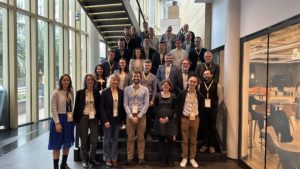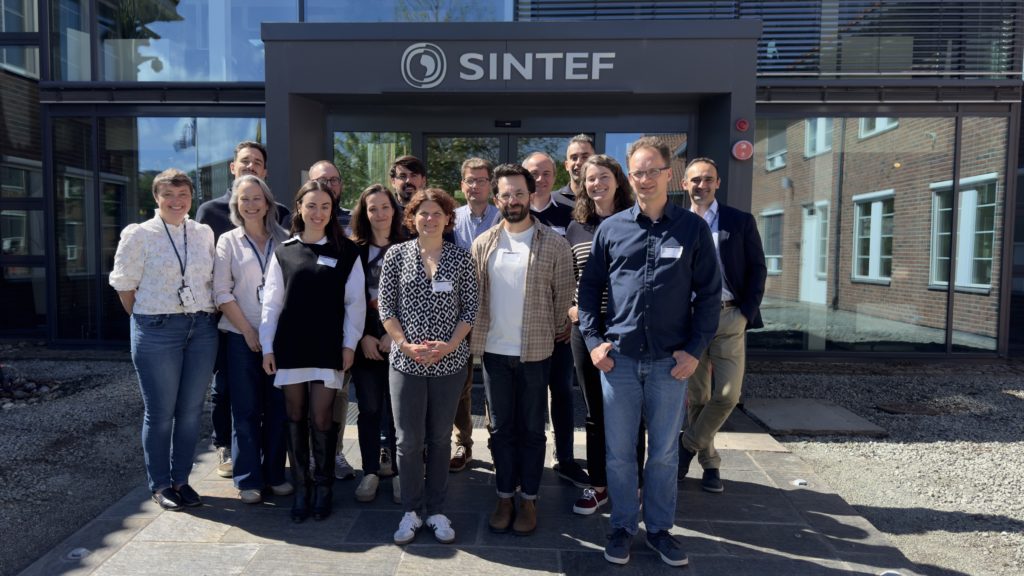
The PilgrHYm partners met on Tuesday, June 2, at SINTEF’s headquarters in Trondheim, Norway, to present updates on the project’s aims. In addition, attendees toured the SINTEF Lab facilities and concluded the day with a meeting of the PilgrHYm General Assembly.
The meeting began with a welcome from SINTEF and a project status update led by NaTran, the lead partner of PilgrHYm. Next, Fluxys reviewed the results obtained from mapping the EU’s natural gas pipelines and the 12 representative steel materials from the European infrastructure to test on hydrogen-induced fracture and fatigue testing.
SINTEF representatives took the floor again to report on the evaluation of experimental methods and the status of the harmonised test matrix. At present, the activities within this work package are focused on two distinct areas. The first is the preparation of a scientific paper based on the review of standards and codes for testing, qualifying, and assessing metallic materials and pipeline infrastructure for hydrogen service. On the other hand, work continues defining the internal guidelines and testing conditions for Slow Strain Rate Tests (SSRT and HSSRT), fracture toughness (FT) tests, and Fatigue Crack Growth Rate testing.
The next technical update focused on the experimental lab tests on the aforementioned selected steel grades, presented by CEA-LITEN. First, the presentation analysed the results obtained from the interlaboratory comparison of the Round Robin Tests (SSRT, HSSRT, and FT). Additionally, it provided an update on the steps to be taken to complete this interlab test campaign, which will conclude in the coming weeks. Finally, CEA-LITEN reviewed the parameters to be addressed in the parametric study and the dedicated experimental data needed for model validation and calibration, contributing to explaining how hydrogen affects these steels under different conditions.
Afterwards, Fraunhofer IWM explained the latest updates on the modelling approach of numerical developments to predict hydrogen damage. First, they outlined the results obtained on the hydrogen-induced fracture model (development, calibration and validation of the model). Then, IWM explained the steps to develop the model for fatigue. The session concluded with a brief presentation of the future steps in the development of mitigation guidelines to limit embrittlement phenomena, by Aragon Hydrogen Foundation, outlining the first steps taken during the last weeks.
Beyond the technical sessions, GERG – The European Gas Research Group analysed the project’s impact in terms of its reach among stakeholders. The group reviewed the actions taken to communicate the PilgrHYm’s progress, the conferences at which the project has been represented, and the strategies to be followed for clustering with similar projects.
The meeting ended with the PilgrHYm General Assembly.
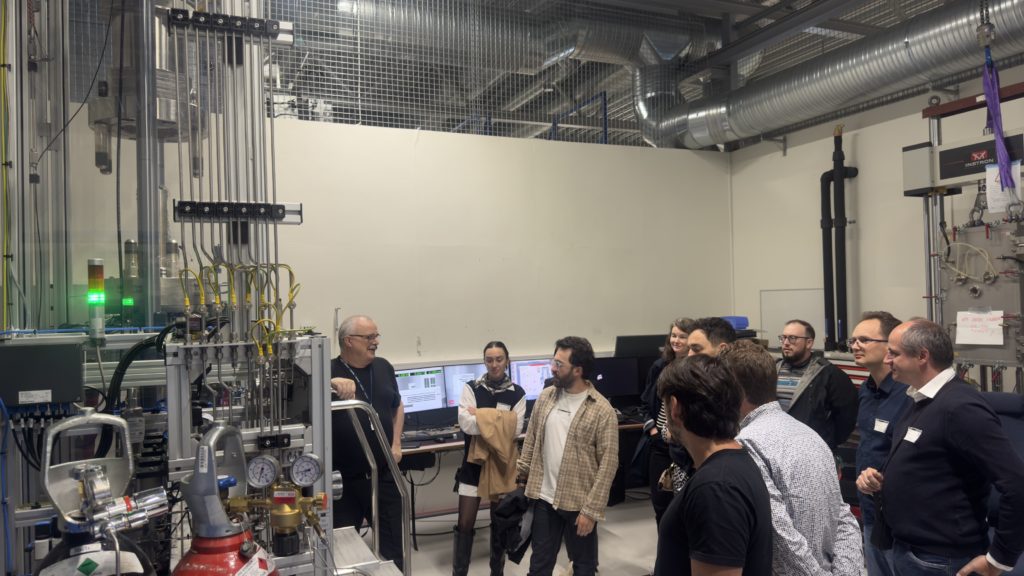
Following the presentations, attendees had the opportunity to take the SINTEF Lab Tour to see firsthand the technical work being carried out both in PilgrHYm and in other projects with similar aims.