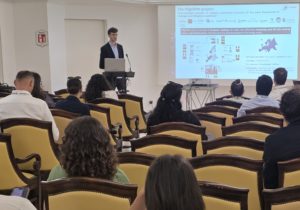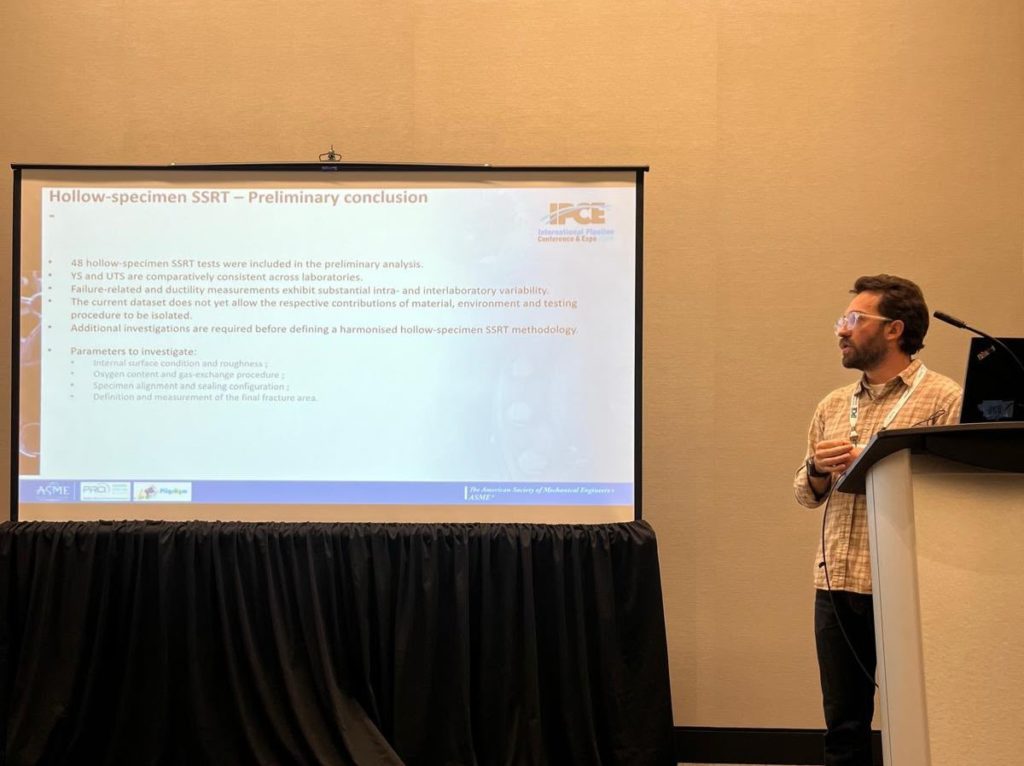
PilgrHYm presented the preliminary results of an interlaboratory round-robin study on tensile testing of pipeline steels in high-pressure gaseous hydrogen at the International Pipeline Conference & Expo (IPCE) 2026, last September 24 in Calgary, Canada. Vincent Farrugia, Pipeline Integrity Research Engineer at NaTran, outlined the main observations extracted from the testing and the next steps towards a final validated protocol to support the repurposing of natural gas pipelines to hydrogen.
The round-robin was designed to tackle four key issues. First, the observed variability between laboratories when testing is conducted with the same materials and the same testing conditions. Second, to verify whether the common testing requirements are sufficient to obtain consistent measurements. Third, the laboratory-specific parameters that may influence the results. And finally, the methodology aspects to be harmonised before extending the testing campaign. Importantly, the objective was not to obtain identical results from every laboratory, but to quantify and understand the remaining variability and assess the robustness of the testing methodology.
For the campaign, two longitudinally welded European pipeline steels were selected to represent different generations of infrastructure. The first was a modern L415 (X60) SAWL steel manufactured in 2008, while the second was a vintage X65 SAWL steel manufactured in 1982. Both materials were tested in nitrogen and high-purity gaseous hydrogen.
The testing campaign was carried out in nitrogen and hydrogen at 85 bar and room temperature, using a nominal strain rate of 10⁻⁵ s⁻¹. Specimen orientation, nominal geometry and machining were common requirements, while each laboratory retained its own approach to gas exchange, instrumentation and the measurement or calculation of force and displacement. Oxygen content was monitored where possible, with a target below 1 ppm, to evaluate how robust the methodology remains under realistic laboratory practices. The preliminary analysis included 72 conventional Slow Strain Rate Tests (SSRT) and 48 hollow-specimen SSRT tests.
The results showed that conventional SSRT showed comparatively consistent results across laboratories, particularly for yield strength and ultimate tensile strength, while ductility-related measurements such as reduction of area displayed greater variability. For hollow-specimen SSRT, the results showed additional variability, particularly in failure-related and ductility measurements. Further work is therefore needed before a harmonised hollow-specimen methodology can be defined. The results point towards several priorities for future harmonisation, including strain measurement, specimen geometry, final-area measurement, gas preparation and common post-processing rules.