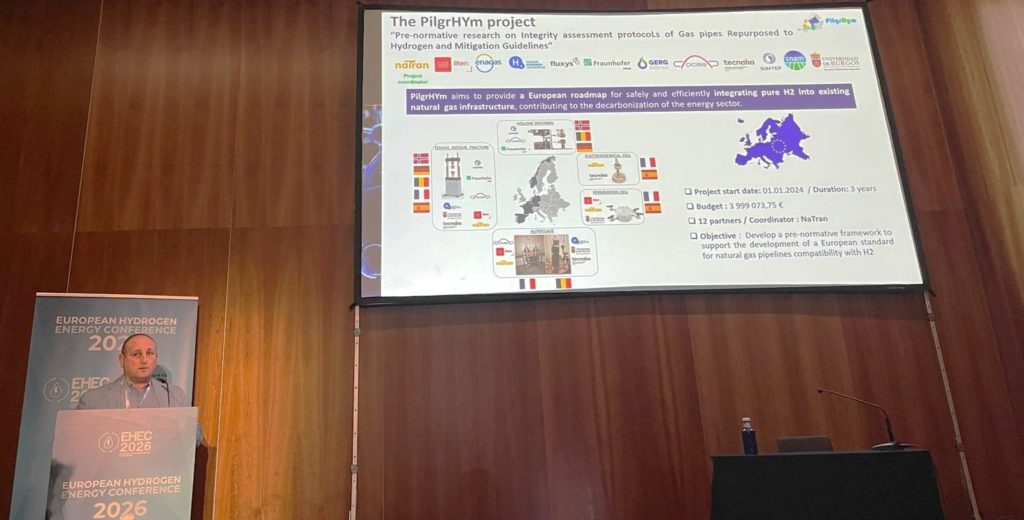
The PilgrHYm project made its appearance at the European Hydrogen Energy Conference 2026 held in Seville, Spain. On March 12, Ivan Montero Puñal, Equipment & Materials Expert at Enagás, discussed the progress made during the first half of the project and outlined the challenges to be addressed in the second half.
The presentation started with an explanation of the first work package, which focused on the selection of 12 materials (eight base metals, two welds, and two heat-affected zones) representing the European pipeline network to be tested in PilgrHYm. After, it was time to know about the testing condition definitions and test protocol development that is being carried out in the project, while also highlighting the methodology used during the round-robin tests.
After outlining the materials and methods selected for the testing campaign, the current status of the campaign was explained. Specifically, the presentation pointed out the status of the Slow Strain Rate Tests (SSRT), SSRT on hollow specimens, and fracture toughness tests carried out during the Round Robin test. The last block focused on how PilgrHYm is investigating and providing approaches for modelling fracture and fatigue in structures under hydrogen-induced degradation. After conducting a literature review of more than 30 articles (focusing on the modelling of hydrogen embrittlement, fracture, and fatigue, as well as the main damage mechanisms of pipeline steels), the different models selected to assess the fracture and fatigue, and the first development on the fracture model were explained.