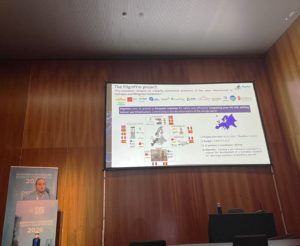
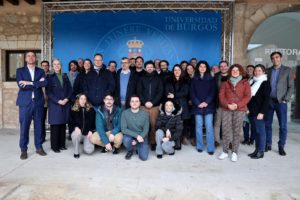
PilgrHYm project held a Stakeholder Workshop on Friday, December 12, to present the progress made so far, now that the project is halfway through. For two hours, more than 100 attendees listened to the leaders of the different work packages talk about the developments made by PilgrHYm during this first stage and the challenges it faces for the second part of the project.
Magali Polo, project coordinator and Project Manager at NaTran, welcomed the attendees and explained the different scopes and objectives of the project. PilgrHYm is a project that will deliver comprehensive guidelines to transmission system operators to assess the feasibility of using pure H2 in existing natural gas pipelines.
Following this first presentation, Julien Schweicher, Green Gas Study Engineer at Fluxys, explained the work on the first work package, which focused on gathering the characteristics in terms of geometry, material, fabrication and operational conditions of the European network and selecting twelve materials (eight base metals, two welds, and two heat-affected zones) to be investigated by testing laboratories. Julien Schweicher highlighted the great response from European TSOs, as 23 TSOs have contributed to this research.
The next part of the workshop focused specifically on the procedures followed for the Round Robin Tests, as well as providing the initial results of these tests. Laurent Briottet, Scientific Advisor for the mechanics and assembly processes at CEA-Liten, explained how they will focus on defining and developing possible set-up designs and testing protocols tailored to reduce the time and cost of current testing procedures. In addition, Laurent Briottet also detailed the work being carried out within the framework of WP3, focusing on the experimental lab tests on the aforementioned steel grades.
The last technical block focused on how PilgrHYm is investigating and providing approaches for modelling fracture and fatigue in structures under hydrogen-induced degradation. Adrienne Muth, Research Scientist at the Fraunhofer Institute for Mechanics and Materials, explained which models have been selected for fatigue and fracture and presented the first development on the fracture model. After these presentations, Lidia Martinez, Coordinator of Hydrogen Conditioning and Transport at Fundación Hidrógeno Aragón and Magali Polo gave attendees a brief explanation of WP5 (Mitigation guidelines towards limiting embrittlement phenomena) and WP6 (Design code & standards optimisation), which will begin their activities in 2026.
The great reception with meaningful discussions and the high attendance at this workshop confirm the importance of the research we are conducting. PilgrHYm continues to take steps forward in its commitment to greater use of hydrogen, investigating the insertion of this gas into the current natural gas infrastructure, a measure that contributes to the decarbonization of the energy sector.